
Crane Projected Versus Actual Release
TDCJ uses “Projected Release Date” for an administrative estimate based on sentence structure, credits, eligibility, and the release mechanism expected to apply. Its current record may also show Maximum Sentence Date, Parole Eligibility Date, and a Scheduled Release block. Those labels are not synonyms. Eligibility opens a review point. A scheduled date is closer to operational planning. Neither proves that the person left the institution.
A Crane County pretrial detainee has no sentence-based date. Bond action, dismissal, a court order, filing decisions, or a detainer may control release. A sentenced county-jail inmate may have a time sheet and jail credit, but that local calculation is not a TDCJ projection.
Find Crane Projected Release Dates
First identify whether the person is held by Crane County or TDCJ. The public TDCJ Offender Information Search covers only people currently incarcerated in a TDCJ facility. It accepts a name, TDCJ number, or SID number, with gender and race options. A county-only jail case will not appear merely because it occurred in Texas.
- Confirm the full name, birth date, and any booking, TDCJ, SID, or cause number.
- Ask the Crane jail whether the person is pretrial, serving a county sentence, or transferred.
- For a county sentence, request the judgment, jail credit, and sheriff's time sheet.
- For state custody, search TDCJ and record every label with the “as of” date.
- Obtain the judgment to identify offense date, sentence, and concurrent or consecutive terms.
- After release, request the actual release certificate, movement entry, or discharge record.
The broader identity and custody ladder is available through the Crane County released inmates lookup.
Texas Good-Time Release Rules
Texas has no universal rule that every prisoner serves 85 percent. That shorthand can misstate the law. The calculation can turn on offense date and type, a deadly-weapon finding, sentence length, concurrent or consecutive terms, jail credit, parole eligibility, mandatory-supervision eligibility, and the law in force when the offense occurred. Government Code Chapter 508, especially Sections 508.145 and 508.149, supplies central current rules.
For many categories, parole eligibility combines calendar time with accrued good-conduct time, subject to minimums and exclusions. Serious-offense rules sometimes called “3g” rules come from an older label; the current statute and judgment should control. The Board retains discretion when parole review is available. Eligibility never equals approval.
Government Code Chapter 498 governs good-conduct time in TDCJ. Credits affect calculations only as law allows. They do not shorten the judicial sentence into a promised discharge date and are not a vested right. TDCJ remains the authoritative state calculator.
Why Crane Release Dates Change
A projection reflects facts known and rules applied at that time. Changes can move the date or change where the person goes. Even TDCJ's Scheduled Release Location can shift when another agency has a valid detainer.
| Factor | Possible effect |
|---|---|
| Discipline or classification | Forfeiture, restoration, or credit-class changes can alter the calculation. |
| Credit correction | Added or removed jail credit changes time served. |
| Court order | A corrected sentence, new judgment, or consecutive term changes the base. |
| Parole vote | Approval, denial, later review, or a required program affects timing. |
| Detainer or hold | The person may transfer to another custodian rather than enter the community. |
| New conviction | A new term or commitment can replace the expected path. |
An FI parole approval is still not an actual release. New information, a required program, a detainer, or final TDCJ processing can intervene. Record both the source and retrieval date whenever a projection is shared.
Confirm Crane Actual Release
For a local case, call the Crane County jail at 432-558-3571 and ask whether custody ended, the actual date and time, the reason code, and whether another agency received the person. A booking/release sheet or final movement entry is stronger than disappearance from a roster. The court file can explain bond, dismissal, sentence, or probation but may not show the physical gate time.
For TDCJ, its public search is prospective and current-custody only. General locator information is available at 936-295-6371 or 800-535-0283. Before a favorable Board vote, use 844-512-0461 for review status. After a vote to release, call Parole Division release status at 512-406-5202. For lasting proof, use the TDCJ Public Information Act route for release and discharge history.
A VINELink Release Check may give notice of a custody change when the correct agency participates. Confirm every alert with the custodian and read transfer, parole, bond, and discharge as distinct events.
Two Crane Time-Credit Systems
Crane users may cross two different time-credit systems. A county-jail calculation comes from the local judgment, jail credit, and sheriff-administered time sheet. Texas Code of Criminal Procedure article 42.032 governs county-jail commutation for good conduct in qualifying cases and gives the sheriff administrative duties. Local application and exclusions matter. No verified source established Crane County's implementation details, so do not estimate the result.
A TDCJ calculation applies Chapters 498 and 508 to a state sentence. It cannot be copied onto a county-only sentence. Conversely, a county time sheet cannot predict a TDCJ parole or mandatory-supervision date after transfer. Ask the current custodian for its own calculation and keep the judgment beside it.
The record shown below comes from the official state search. View TDCJ's name, number, and SID search fields.
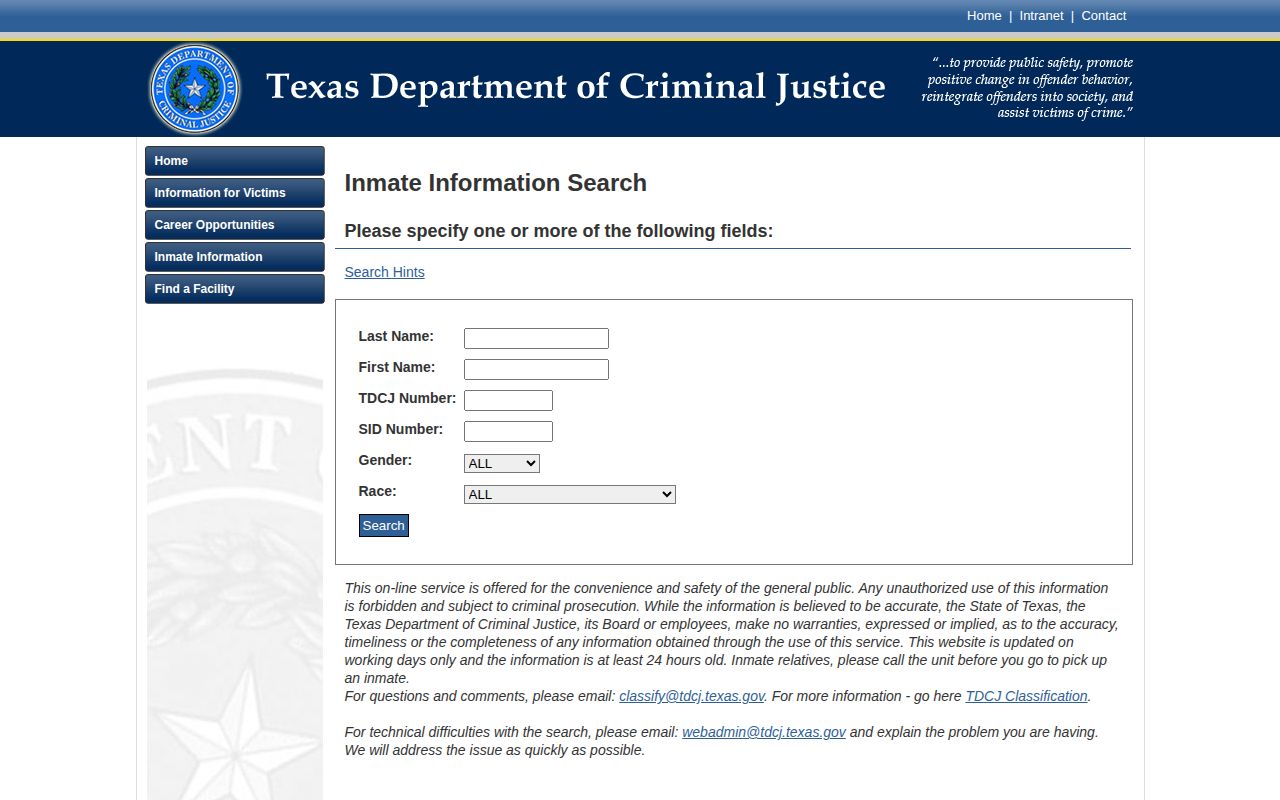
The screenshot supports the state lookup route; it does not show an actual release and does not cover a county-only jail sentence.
Crane TDCJ Release Labels
The current results table can show name, TDCJ number, race, gender, projected release date, unit, and age. A detail record adds SID number, maximum sentence date, current facility, parole eligibility date, and offense history. A Special Information for Scheduled Release block may list scheduled date, type, and location, or placeholders if nothing is scheduled.
Projected release is an estimate. Maximum sentence date is the calculated sentence end absent another legal basis. Parole eligibility marks when review may begin. Scheduled date, type, and location describe current planning. After the person leaves, the public current-inmate search may no longer return the record. A no-result therefore does not prove release.
- Projected release date
- TDCJ's current administrative estimate.
- Maximum sentence date
- The calculated end of the sentence, not always the exit date.
- Parole eligibility
- A review milestone, not approval.
- Detainer
- Another agency's request or legal basis to assume custody.
Note: Preserve the exact label and date observed, then replace the estimate with the actual movement or discharge record after release.
Crane Historical Release Proof
A person who has completed TDCJ release will ordinarily drop out of the current-inmate public search. Repeated searches do not reveal a hidden released-person page. Use TDCJ's offender-information email or telephone routes for history, then make a formal request when the answer must last. Ask for incarceration history, actual release date and mechanism, maximum expiration or discharge, release certificate, and responsive movement records.
For a Crane County jail event, direct the request to the sheriff as record custodian. Ask for the booking/release sheet and final movement entry. The combined County and District Clerk can supply the judgment and later court orders, but the court file may not show the jail's physical departure time. Match the cause number, booking number, and person across both sets.
A negative current search should be stated as a timed observation, not a release conclusion. It can also reflect spelling, processing lag, county-only custody, another jurisdiction, or a legally restricted record.
Crane Parole Release Timing
Parole review adds another set of dates. Texas does not hold formal hearings for each named person. Board panel members review and vote files, so there is no Crane County parole-hearing calendar that predicts an exit day. The process can begin months before eligibility, and a denial states the next review date. That review date is administrative timing, not release.
Vote codes also require care. FI-1 means release when eligible. FI-2 points to a future month and year. Several FI codes ending in R require a specified program within an approximate period. NR sets a next-review month and year, while SA directs service of the balance without regular review. DMS denies discretionary mandatory supervision and sets another review. The live Board vote-options source should be checked because codes evolve.
Even a favorable FI decision does not prove departure. New information can cause withdrawal. A required treatment or education program may not yet be complete. A detainer may direct the person to another custodian. TDCJ also must finish release processing and identify the release type and location. Use Parole Division release status after a favorable vote, then obtain the actual movement or release record.
Three records therefore answer three questions. The eligibility date says when review can occur. The panel vote records the Board's decision. The TDCJ release record confirms that the person left the institution and explains the mechanism. Do not replace the third record with either of the first two.
Request Crane Release Calculations
When a displayed date seems wrong, gather the judgment before asking the agency to explain it. Note the offense date, sentence date, term, county, case number, jail credit, and whether sentences run together or one after another. Ask TDCJ to verify the values in its record and identify the current projected, maximum, eligibility, and scheduled fields. The agency, not a hand calculation, should resolve the estimate.
For a county sentence, ask the Crane sheriff for the time sheet and the clerk for the judgment and jail-credit order. Do not assume the clerk calculates release or that TDCJ rules apply. If another agency placed a hold, identify that agency and whether the next event is a transfer. A release date without destination can hide continued custody.