
Crane County Booking Photo Meaning
A mugshot is an image associated with an arrest, jail booking, or correctional record. It records an event, not the final result of a case. Someone can be photographed and later released on bond, have a charge dismissed, complete a sentence, transfer to another custodian, or receive another disposition. The photo does not answer which outcome occurred.
Release also does not erase the image from the originating record by itself. Access may still be affected by a lawful exception, juvenile confidentiality, expunction, an order of nondisclosure, mistaken identity, or a correction. The current custodian decides a public-record request. A dated release sheet and the criminal case file are better sources for current meaning than the picture alone.
- Booking photo
- The photograph linked to a specific jail or correctional intake.
- Expunction
- A court-ordered process under Texas law that can remove eligible records.
- Nondisclosure
- A court order that limits public disclosure of qualifying criminal-history information.
- Disposition
- The court’s recorded outcome for a charge or case.
Crane County Mugshot Sources
Each channel has a different scope. Crane County has no verified sheriff photo roster, recent-release photo feed, or mobile app. A direct sheriff request is therefore the local route. State prison images belong to TDCJ records, not to the Crane County booking, while news and commercial copies need verification against the originating office.
| Channel | Photo status | How to use it |
|---|---|---|
| Crane sheriff roster or release feed | No official photo feed verified | Do not assume an online window or retention period. |
| Crane sheriff records request | May hold the booking photo | Identify the booking and request the image separately. |
| Sheriff mobile app | No official Crane app verified | Do not substitute another county’s app or a vendor page. |
| TDCJ public search | Photo not promised | Use a formal TDCJ request for a responsive institutional image. |
| Official release or news report | May preserve a dated arrest image | Read it as a record of the reported event, then verify status. |
| Commercial directory | May show copied material | Treat only as a lead; stale or misidentified images are possible. |
VINELink is useful for custody events where the agency participates, but the research does not establish it as Crane County’s official mugshot source. Likewise, a TDCJ institutional photograph is not the same item as a Crane County jail booking photo.
Crane County Has No Photo Feed
The official Crane County Sheriff page was checked for an inmate roster, recent-release view, photo gallery, and mobile app. None was verified. The page does provide the official sheriff contact and a link to VINELink, so it remains the proper place to confirm current county channels.
The official sheriff page can be reviewed before making a request:
Open the Crane County Sheriff source shown below.
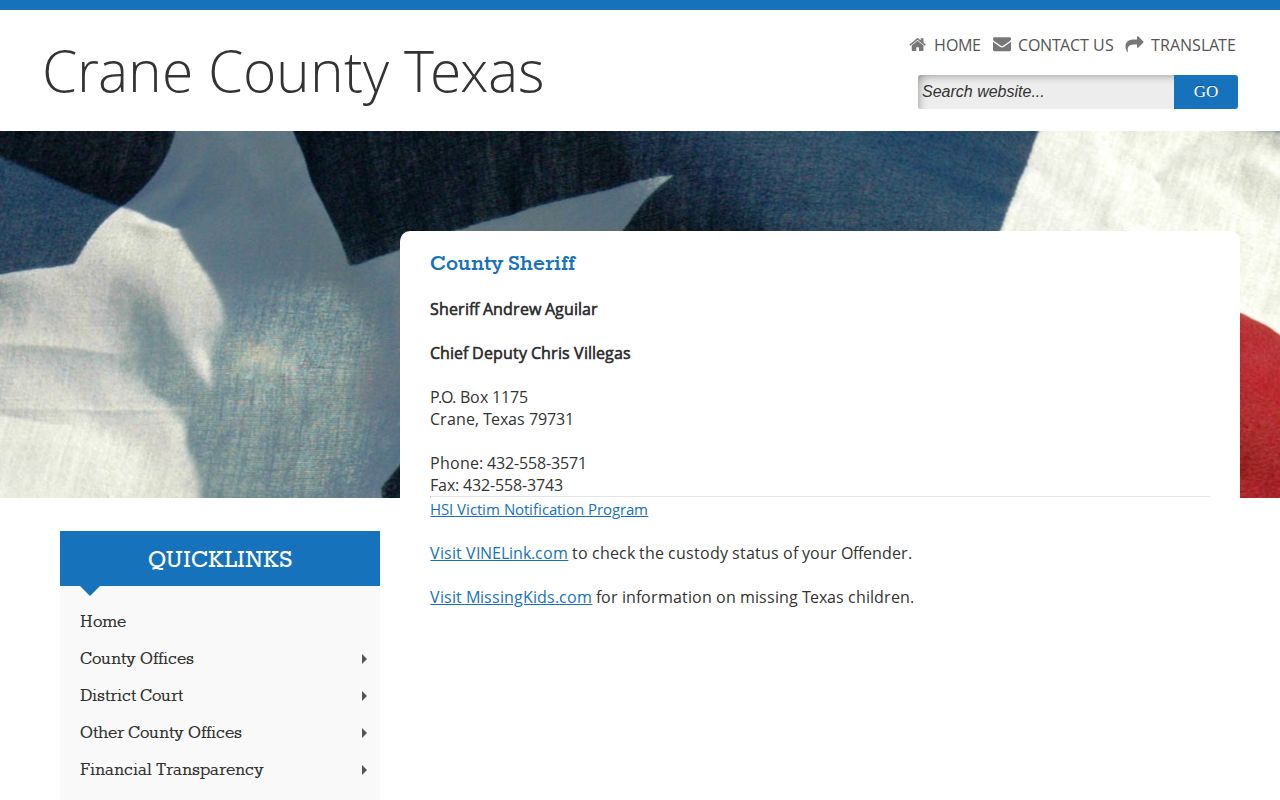
The captured page supports the contact and VINELink route. It does not prove that a public photo roster or release-photo feed exists, and a screenshot does not update itself when county services change.
This local absence makes a booking-specific Public Information Act request the defensible route. Commercial domains that put “Crane County Jail” in a title cannot prove official publication policy, current custody, or the accuracy of a copied image.
Request a Crane County Mugshot
Identify the exact booking before asking for the photograph. The sheriff’s record inventory can be searched more accurately with the person’s full name, booking date, and booking number when known. Request the booking photograph as a separate item from the release sheet. That wording prevents an assumption that a general release record automatically includes the image.
The county provides an official public-record request form. Because the sheriff is the likely custodian of county jail booking records, confirm the correct sheriff or public-information recipient before sending the request. The County Clerk’s role in hosting a county form does not make the clerk the holder of every jail photo.
- Confirm the person’s full name and the specific Crane County booking.
- Add the booking date and booking number if known.
- Ask separately for the booking photograph and the booking and release sheet.
- Use the official form and route it to the correct records custodian.
- Let the custodian identify any exception, redaction, or available format.
No photo fee or sheriff response schedule was established in the research. Do not send payment based on an unofficial directory. The Texas Public Information Act process governs the request, while the agency supplies any lawful cost notice or exception.
Note: Requesting both the image and release sheet preserves context, since the photograph alone cannot prove when or how Crane County custody ended.
Crane County Photos After Transfer
A person moved from the county jail to a TDCJ institution follows a separate record trail. The TDCJ offender-information page states that its informal offender-information service will not provide inmate photographs. The public search should not be described as a guaranteed photo source.
A formal request through TDCJ Open Records can ask for a responsive institutional photograph, subject to the agency’s statutory decision. That image documents the state correctional record. It does not replace the photo tied to the earlier Crane County booking. Ask each custodian for its own record when the distinction matters.
Current TDCJ incarceration also is not proof of a Crane County community release. A movement from the Law Enforcement Center to state custody is a transfer. Match the TDCJ identifier and offense information carefully, then use the sheriff release record to document when county custody ended.
Verify Crane County Photo Copies
An official law-enforcement release or a dated report from a reputable news outlet may preserve an arrest photograph after the source page changes. Such an article proves only what was published about that event. It does not supply a live custody status, a complete court outcome, or a current release date.
Commercial mugshot and jail directories create more risk. Their copy may be stale, mislabeled, or detached from a later disposition. No commercial mugshot publisher is linked here. If a copied image helps identify the possible originating booking, return to the sheriff, court, or TDCJ record for confirmation.
Compare the full name, booking date, agency, and case number before treating two images as the same record. A repeated photograph may have been copied from an older booking. A name match can also belong to someone else. The originating Crane County record should supply the booking-specific identifiers, while the court file supplies the legal disposition.
The Crane County released inmate record search explains how to pair the physical custody event with the correct court or correctional system. Use the image as one identifier, not as the conclusion.
Texas Law on Crane Mugshots
Texas Government Code Chapter 552 governs requests for public information and permits the custodian to apply statutory exceptions. Texas Attorney General Open Records Decision 616 required release of a conviction-linked mugshot on its facts after the image was no longer related to an active investigation. That decision does not erase later statutes, case-specific exceptions, expunction, or juvenile protections.
Code of Criminal Procedure Chapter 55A governs expunction. Government Code Chapter 411, Subchapter E-1 addresses orders of nondisclosure. These remedies differ, and neither should be assumed from a missing web image. The court order and originating agency records control.
Correct a Crane County Photo
Texas Business & Commerce Code Chapter 109 sets duties for certain private criminal-record publishers. Section 109.003 provides a dispute and investigation process for completeness and accuracy and bars a fee to remove, correct, or modify incomplete or inaccurate data. It is not a broad ban on government mugshots and does not create a universal right to erase accurate public information.
Start with the source record. If the wrong image, name, or disposition appears, send the sheriff, court, or TDCJ the authoritative booking and case details. For an expunction or nondisclosure issue, use the signed court order and the process it directs. A private publisher’s copy should be challenged with the corrected source material, not through a paid promise to remove it.
Keep the correction focused on the exact error. Identify the page or record, state what is wrong, and attach the official disposition or corrected identifier that supports the change. Preserve the request and response. If more than one agency holds a copy, each may need the correct order or source record because changing a court entry does not automatically update every later copy.
Note: A missing image may reflect policy, redaction, or a record remedy; it does not by itself prove that the underlying booking never occurred.
Public Record Search
Sponsored Results