
Crane County VINELink Coverage
Texas VINE through VINELink is a custody-information and notification service. The official Crane County Sheriff page links to VINELink, making it the only local custody-status web route found in the research sweep. That link does not prove that every Law Enforcement Center event is in the live feed. Confirm Crane in the agency selector and verify the specific record with the jail.
VINELink reports data sent by participating custodians. It may display the person, agency, custody status, location, and a dated event. It does not replace the sheriff's booking or release record. State-prison custody should not be folded into the local jail path. TDCJ runs a different post-conviction notification system, IVSS, for people in its institutions or under Parole Division supervision.
Search Crane VINELink Records
Use the strongest identity facts available. Similar names can refer to different people, while spelling variants can hide the right record. Do not publish a birth date or identifier. Keep it only to compare the person, agency, and event shown by the official interface.
- Open Texas VINELink and select Texas if prompted.
- Enter the name or identifier fields offered by the live form.
- Narrow results to the correct agency and compare all displayed identifiers.
- Open the matching record and note status, location, event, date, and retrieval time.
- If it says released, call the named custodian to confirm the event.
- If no match appears, try spelling variants and contact the last known custodian.
The Crane County released-inmate search path adds sheriff, court, TDCJ, and federal or immigration channels when VINELink cannot resolve the event.
Crane VINELink Release Fields
Read the exact event wording. A transfer is not release to the community. Escape, death, parole, bond, sentence discharge, and release are distinct. Fields depend on the agency feed, so never fill a blank from another source.
| Field | How to read it |
|---|---|
| Name or identifier | Match more than the name. |
| Custody status | Agency-fed status that may lag. |
| Agency or location | Office that should confirm the event. |
| Event type | Distinguishes release from transfer. |
| Event date | Not always a certified release time. |
Open the official Texas VINELink search shown below.
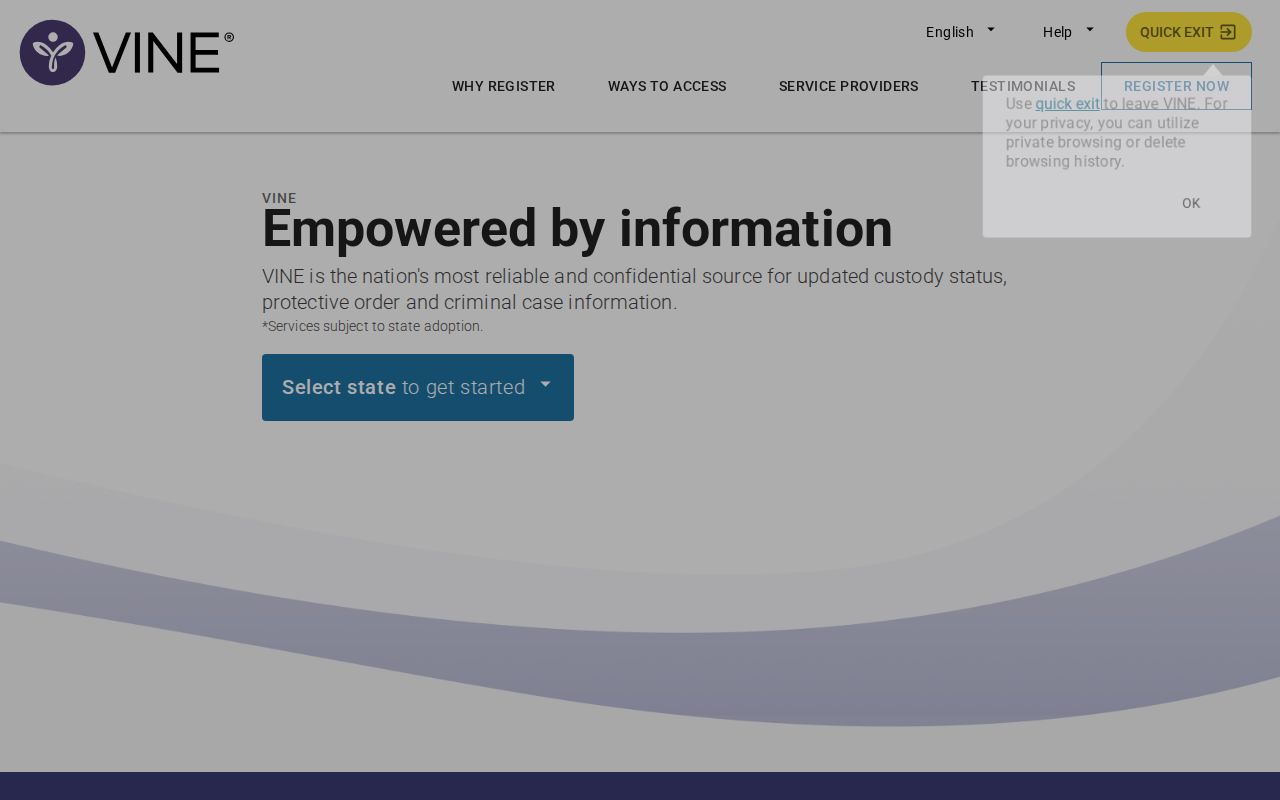
The image demonstrates the entry point, not any Crane County person's status.
If several results share a name, stop before registering. Compare the agency, location, identifier, and any available age or date facts with a trusted record. An alert tied to the wrong person cannot confirm the intended Crane County release. When the interface lacks enough detail, ask the custodian to identify the correct booking number before selecting a record.
Register Crane Release Notifications
Registration begins from the correct person record. Available events and delivery methods change. Select only the custody changes offered on the live screen, enter contact details accurately, and protect the registration information.
- Choose the displayed “Get notified” or registration control.
- Select the offered custody events.
- Choose phone, text, email, or another live option.
- Enter contact information and create a phone PIN if prompted.
- Complete the displayed email, text, or PIN confirmation.
- Save details privately and use VINELink to update or cancel.
An alert reflects data received from the agency and may arrive before or after another system changes. Confirm it directly.
Keep phone and email details private. Do not publish a notification PIN or confirmation code. If contact information changes, update the registration in the live service so a future custody event does not go to an old number or account.
Crane VINELink Release Limits
A missing record proves little. The agency may not participate, the feed may lag, the name may differ, or another system may hold the person. Call the Crane jail at 432-558-3571 for a local booking. Ask whether custody ended, the date and reason, and whether another agency received the person. Request the booking and final movement record for lasting proof.
For current state-prison custody, use the TDCJ offender search. It covers only people then incarcerated in TDCJ and its data is at least a day old. BOP handles sentenced federal prisoners. ICE ODLS handles current immigration detention. VINELink is not a complete BOP, ICE, or state-prison history search.
Crane VINELink Versus IVSS
The sheriff's VINELink route and TDCJ's Integrated Victim Services System serve different tracks. TDCJ Victim Services describes IVSS notices for people in state institutions or under Parole Division supervision. Events can include parole review, release to supervision, discharge, and warrant action.
Register through the official IVSS portal, call 800-848-4284, or email victim.svc@tdcj.texas.gov. TDCJ lists email, letter, text, or combinations. Electronic data process continuously, so a notice may arrive at any hour. It still is not proof of physical release.
A Crane detainee belongs in VINELink only if the sheriff feed participates. A TDCJ prisoner or parolee belongs in TDCJ and IVSS. Federal sentenced custody belongs in BOP, while immigration detention belongs in ICE ODLS. Movement between systems makes the sending and receiving records more reliable than a single negative search.
View the separate TDCJ notification portal shown below.
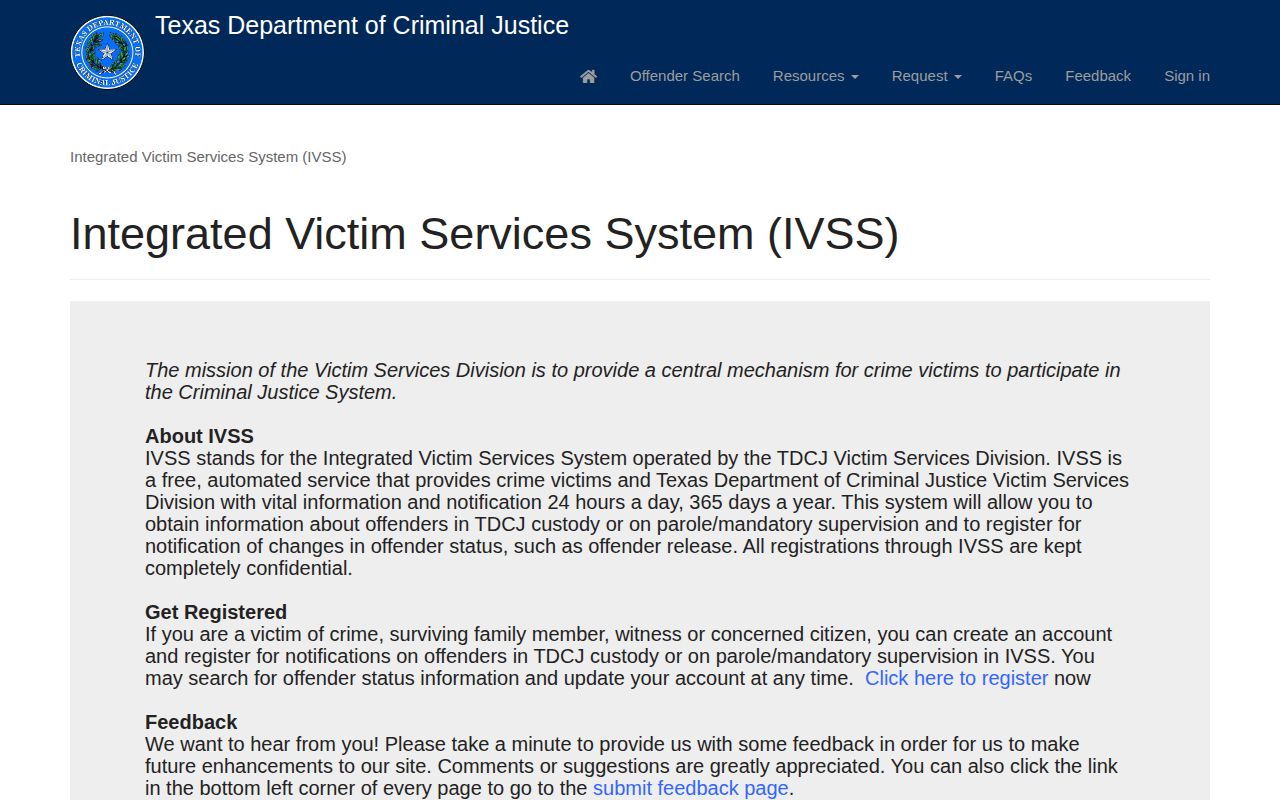
The image marks the state path and does not prove Crane jail participation.
Crane VINELink No-Result Checks
A neutral no-result statement protects against a bad inference. Record that the name was not found in the public interface at a stated time. Then check spelling, an alternate name, the agency filter, and any known identifier. A recently booked person may not yet be in the feed. Someone released outside the online window may also be absent.
Next call the last known custodian. For Crane County, ask the jail whether the person is held now and, if not, request the last custody transaction, its date, the reason code, and the receiving agency. If staff cannot provide a lasting response by phone, request the booking/release sheet under the Texas Public Information Act. A transfer notation sends the search to the receiving jail, TDCJ, ICE, or another authority.
For a filed charge, the Crane criminal case can explain a bond order, dismissal, judgment, sentence, or later supervision action. Court disposition does not always supply the physical release time, so compare the docket with the jail event. That two-record check is especially useful when an alert and a live custody screen update at different times.
Read Crane Release Alerts Carefully
Notification speed and legal meaning are separate. VINELink can be useful because it passes on a participating agency's change event, yet each label still needs context. A bond release from the Crane jail is not parole. A transfer to TDCJ is not freedom. A move to ICE is continued federal civil custody. Sentence discharge means the sentence obligation ended, while release to supervision means legal controls remain.
Write down the event exactly as delivered. Include the date, time received, named agency, and any location shown. Then call that agency. Ask whether the alert reflects physical departure, administrative processing, or transfer. If another custodian received the person, continue with that system rather than registering the event as a community release.
Alerts also should not be used to reconstruct dates that the service did not supply. For a precise Crane County jail time, request the release sheet or movement log. For a state-prison history, request TDCJ's release certificate, discharge record, or movement history. Those agency records remain the sound evidence if an alert arrives late, repeats, or conflicts with a public screen.
- Custody change
- A broad event that can include movement without freedom.
- Out of custody
- The named agency no longer holds the person; another agency may.
- Release to supervision
- Exit from secure custody under parole or mandatory-supervision rules.
- Discharge
- End of the stated sentence or supervision duty.
Confirm Crane VINELink Releases
The sheriff's release transaction is the best local check after a Crane VINELink alert. A focused request should name the person and approximate booking period, then ask for booking date and time, release date and time, release authority or reason, charges, bonds, holds, and the receiving agency or destination if transferred. The county's general request form is a written channel, but sheriff-held jail data should be routed to the sheriff or public-information officer.
Texas Government Code Chapter 552 applies to existing public information. It does not require Crane County to create a new answer or custom report. Some fields can be withheld or redacted under a lawful exception. Ask the office to identify the basis and provide all reasonably separable public parts. A narrow person-and-date request is easier to locate than a broad demand.
The court record serves a different purpose. It may show the bond order, dismissal, judgment, sentence, probation order, or warrant that explains why custody changed. It may not capture the exact jail-door time. Compare the sheriff record and the Crane criminal case whenever both the physical event and legal reason matter.
For TDCJ, the informal email route can supply incarceration and offense history when available, but it does not provide photographs. A formal TDCJ Public Information Act request is the right channel for an actual release certificate or discharge history. VINELink and IVSS remain notice tools, while the custodian's responsive record supplies the durable proof.