
Crane Parole and Probation
Parole and mandatory supervision belong to the Texas state-prison path. The TDCJ Parole Division manages people released from a TDCJ institution under conditions, while the Texas Board of Pardons and Paroles makes release decisions. The person is outside the prison, but the sentence has not necessarily ended. Probation, called community supervision in Texas law and practice, comes from a court. Crane County Community Supervision and Corrections Department, or CSCD, supervises the local order. Probation may follow a jail term, or it may begin without any TDCJ confinement.
A county booking alone does not identify the supervision type. Read the judgment and match it to the supervising agency. A TDCJ number, parole vote, or state release certificate points toward parole. A Crane criminal judgment placing the defendant on community supervision points toward probation. The distinction controls where to ask for status, conditions, discharge, and violation records.
| Point | Parole or mandatory supervision | Probation |
|---|---|---|
| Source | Release from TDCJ custody | Order of a trial court |
| Decision maker | Texas Board framework | Crane County court handling the case |
| Supervisor | TDCJ Parole Division | Serving CSCD |
| Proof | TDCJ status plus release record | Judgment, docket, and CSCD confirmation |
| End point | Discharge or maximum expiration | Court-ordered completion or discharge |
- Parole
- Conditional release from state prison before the full sentence expires.
- Mandatory supervision
- A Texas release mechanism governed by eligibility law and, for many cases, Board review.
- Probation
- Court-ordered community supervision that does not prove a prison release.
- Discharge
- The end of the supervision or sentence obligation, not erasure of the underlying case.
Verify Crane Post-Release Supervision
Start with identity and sentence facts, not a guess based on where the person lives. Crane County residents can be assigned outside the county, and a transfer of residence can change the reporting office. TDCJ's public offender search covers people currently incarcerated in a TDCJ facility, so a missing result is not a parole discharge. For someone already released, use TDCJ offender-information contacts and the Parole Division. For probation, locate the Crane case and ask the court or CSCD that holds the supervision file.
- Confirm the full name, date of birth, cause number, and any TDCJ or SID number without publishing those identifiers.
- Read the Crane County judgment to see whether it imposed community supervision or committed the person to state custody.
- For a state-prison path, check TDCJ offender information, then ask Parole Division for current status and office assignment.
- For a probation order, contact Crane County CSCD and match the response to the court cause number.
- Ask whether supervision is active, transferred, discharged, revoked, or subject to a warrant, and note when the information was received.
- Obtain the release or discharge record when a durable historical answer is needed.
Crane Supervision Office Routes
TDCJ's official county cross-reference assigns Crane to the Region V Monahans District Parole Office. That office handles parole and mandatory-supervision matters, not probation and not the Crane jail's booking records. The local CSCD handles court-ordered community supervision. Contact details can change, so confirm the current referral in the TDCJ county cross-reference or the Community Justice Assistance Division resources before reporting.
Monahans District Parole Office
401 South Allen Avenue
Monahans, TX 79756
432-943-7254
Fax: 432-943-7397
Use for TDCJ parole and mandatory-supervision status after state custody.
Crane County CSCD
201 W. 6th Street, Room 200
Crane, TX 79731-2503
432-558-1107
Fax: 432-558-1184
Use for court-ordered probation and the current supervising-office referral.
Crane Supervision Violations
Conditions are rules attached to release or a court order. They may require reporting, approved residence, program participation, travel permission, or other conduct stated in the person's documents. The actual order controls. An old summary cannot show whether a term was changed, transferred, completed, or waived. Ask the supervising office about current status, and use the criminal docket for a filed motion or court action.
An absconder is a person alleged to have stopped reporting or left supervision without permission. That label is not proof of a new conviction. A parole warrant can leave someone physically outside a facility while subject to arrest and return proceedings. Probation violations are handled through the court and can result in modification or revocation. Check TDCJ warrant/status contacts for parole and the Crane case docket for probation. Government Code Chapter 508 supplies the state parole and warrant framework.
VINELink may send custody-change alerts when a participating custodian supplies the event, but it is not a complete supervision-status service. TDCJ Victim Services' IVSS is the separate post-conviction system for people in TDCJ custody or under Parole Division supervision. A warrant action, transfer, release to supervision, and final discharge are not interchangeable events.
Crane Supervision Discharge Records
Supervision can end through completion, discharge, maximum expiration, court action, revocation, or another event allowed by the controlling order and law. For parole, obtain TDCJ incarceration and release history, the release certificate, and the record showing discharge or maximum expiration. TDCJ's open-records route handles formal requests. For probation, ask the combined Crane County and District Clerk for the judgment, later orders, and any discharge entry, then confirm status with CSCD.
A discharge does not automatically erase a conviction or booking. Expunction and nondisclosure are separate legal processes, and restricted records may no longer appear in a public search. The full county custody and case lookup begins on the Crane County released inmates search. Match each supervision document to the same cause number and person before treating it as final.
Public status data can lag. Record the date, agency, and exact wording of any response. For a historical claim, keep the actual discharge document rather than a screenshot of a changing portal.
When the Crane court file and supervision office appear to conflict, compare their dates and roles. The clerk preserves filed orders. CSCD or Parole Division reports the current administrative assignment. A later transfer, modification, revocation, or discharge can explain the difference. Ask for the document or status entry that changed the case. A silent docket does not prove that reporting duties ended.
Crane Parole Review Records
Texas does not hold formal individual parole hearings. The Board's official parole-panel FAQ explains that panel members review and vote files. There is no Crane County inmate hearing calendar. Board public meetings concern agency business and should not be read as a calendar of named release cases.
Three members vote in sequence, and two matching votes decide the case. FI-1 means release when eligible, while FI-2 names a future month and year. Several R-coded FI results require a program before release. NR sets another review period; SA directs service of the sentence balance without regular review; DMS denies discretionary mandatory supervision and sets another review. Codes can change, so use the live Board vote-options page. A favorable vote is not the gate event. Programs, new information, detainers, and TDCJ processing can delay or redirect custody.
Before a favorable vote, the Board status line is 844-512-0461. After a vote to release, TDCJ Parole Division release status is 512-406-5202. The eligibility date, panel decision, and actual release record mark three different events. The screenshot below comes from the official Board source and documents the absence of formal named-person hearings.
View the Texas parole-panel explanation.
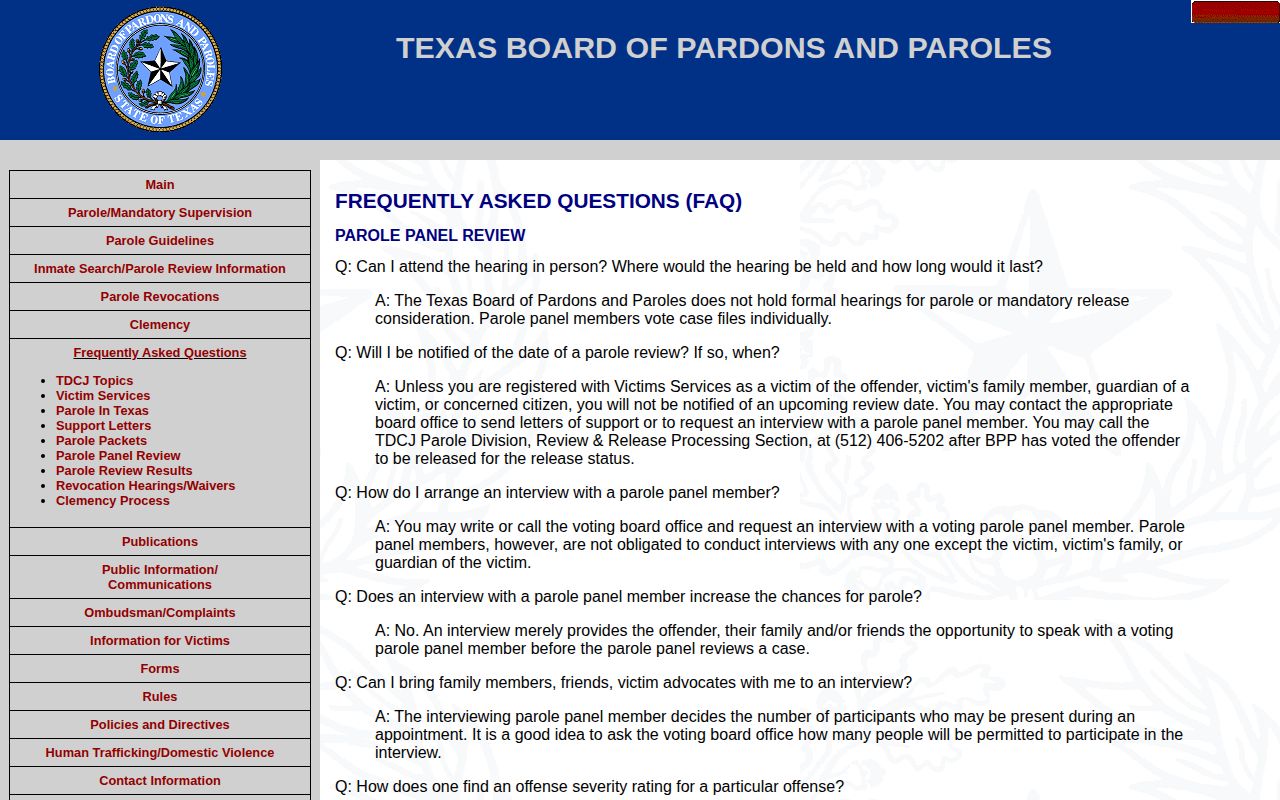
The image supports the file-review distinction; it does not report any person's vote or release.
Crane Parole Reentry Referrals
No county-run Crane reentry office was verified. TDCJ's Reentry Resource Guide places Crane within a broader West Texas service landscape that includes Ector, Upton, Pecos, and Ward resources. A nearby listing is a regional referral, not a Crane County program. Confirm that the provider still operates, serves the person's present address, and accepts the referral before relying on it.
The TDCJ Rehabilitation and Reentry Division is the sound starting point for state-prison release planning. Probation needs should be routed through the CSCD and court order instead. A transfer of supervision can also change the correct region, so residence and current office assignment matter more than the county of conviction alone.
Two Crane Supervision Systems
Crane residents may report through two distinct systems. TDCJ Parole Division handles parole and mandatory supervision after state custody. The serving CSCD handles probation ordered by a court. The office may sit outside Crane County, and residence transfers can move a file. This is why the current supervising-office referral is more reliable than a guessed address or an old directory.
Ask one direct question: which agency holds the active supervision file today? Then request the status from that agency. If one office says the case transferred, obtain the receiving office name. Keep the court order or TDCJ release document with the response so the supervision type remains clear.
Residence also may differ from the county of conviction. A person convicted in Crane can report elsewhere after an approved move, while a Crane resident may have a case from another county. The current office referral resolves that practical question. It does not rewrite the judgment or prove that all conditions are complete.
Note: Crane County conviction, residence, custody, and reporting location may all differ, so verify the active office before making contact.